Thursday, 19 January 2012

Tunisia: The Arab Country that ignited the Arab Spring

Tunisians celebrate the one-year anniversary of the revolution that kicked off the Arab Spring.


Tunisia celebrated the first anniversary of its January 14 revolution, when the autocrat residing in Carthage had to flee.


There are many ways of marking a historical benchmark such as the ousting of a dictator. But what is the significance of January 14? Is it just a question of a national day - or even a Pan-Arab day - when the Arab Spring sprung? Is it about enumerating the anniversaries of a spectacular escape? Or is it an idea and an ideal requiring renewal and stock-taking?
Its about taking a stand, telling the dictators that your "permanent" chains have been broken. Its about raising your voice. Its about changing the face of Tunisia. Its about, the people.


In year one of the revolution, everything must be about directed at giving meaning to the word "people" - in politics as well as in the arts - in every sphere where peoplehood must mean sovereign, sublime, ennobled and sacred.


Unfortunately, the Arab dictators ignored the early subtle waning signs of reaching the people's demands, so they brought about a revolution, its that simple. It will soon change the face of the Arab World, affecting the Arab diaspora which is primarily in Latin America. 

"The people will"  a phrase that is destined for a career in any demos. A people who will also do not will. It is the double meaning that makes it spectacularly an embodiment of people, people hood and a sovereign people.  It has a special ring to it - and only on 14th of January it reverberates when chanted en masse, echoing zest in the expression of will, determination, invincibility and people hood. That was in Cairo, as hundreds toured around Tahrir Square and neighbouring streets chanting "the people's will [is] for the field marshals to depart".

Although, I assume, Tunisia isn't aware of what change they have caused, ousting Ben Ali was only the beginning, more than 15 Arab countries have successfully followed, although none of them are successful, as of yet. Regardless of Gadaffi or Mubarak's throne being be throttled by the people, their countries are still torn to bits. With bitter scars among the people and their hearts, metaphorically and literally, As well as other Arab countries who are in turmoil as I write this, Syria, Yemen, Bahrain and Saudi Arabia who is waking up as well. What do we need? What will prevent all these innocent deaths? How will this issue be solved? Unity of the Arabs. Not unity of the Power. But unity of the People, the Arab people, regardless of religion, the Arab revolutions are bringing about, an Arab Republic. Where soon, America and Israel will be shaking in their knees
Unfortunately, only clocks have mouths, and only time will tell.


Endless images depict the conception of the Arab Spring in Tunisia a year ago. The man in a shooting posture playing out some kind of "exterminator", spraying imaginary bullets with a baguette at a long line of police riots in the Habib Bourguiba Boulevard representing words that one cannot express from their mouth,
Defiance for bread and resistance for freedom are inseparable. People were not hungry. Or rather, they were hungry - for the enabling means to be, to share a homeland as equals, to provide, and to feel free.
The bird cages lifted high, their doors open, metaphorically giving their imaginary residents an opening - from which they flutter their wings on a much vaunted flight of freedom - was one of the memorable tableaux vivants of that revolution.

The Tunisian people have brought to the public sphere - when resisting in January 2011 and when voting in October - the intelligence, defiance, resources, creativity, and norms worthy of a government matching what they achieved: releasing imaginary birds of hope into freedom, and forcing one infamous dictator on an aimless 
one-way flight out of the country of the free, and soon, the Arab countries will all be free from all the lies and hypocrisy that had "accidentally" spilled from US & Israel all over the Middle East. 

Thank you for reading.

Follow me on twitter; @OhSweetArabia


Thursday, 5 January 2012

The Libya Revolution; What Now?


With the fall of Muammar Gaddafi’s 41-year dictatorship in Libya, the year of Arab revolutions has taken a game-changing turn, not just for the peoples of the region seeking systematic and large-scale political change - but for geopolitics at a global level. As Libya now joins Egypt and Tunsia helping their fellow sisters Syria, Yemen, Bahrain, Jordan and Palestine overthrow their dictators.
Regardless of the outcome of the Libyan Revolution, their are still important aspects and factors that need to be considered and are questionable.
Will their be a New Libya?
Will the Libyans finally achieve what they longed for?
Will the Western World involve itself and control Libya?
And Are the deaths of many really worth it? 
  It is time for the Libyan people to celebrate the end of a four-decade dictatorship. Once they sober up from the jubilations of their well-deserved victory, however, they will discover this is only the beginning.
  Gaddafi has undermined, marginalised or obliterated many of the state institutions, including the military, and destroyed the political parties - indeed, political life in the country. There is much to restore and more to build from scratch. Security, reconstruction and political transition are only a few of the challenges they will face sooner rather than later. More importantly, they will need to manage expectations of those who have given their all for liberty, freedom and prosperity.
And judging from what we have seen over the past 10 or so months, there is much to celebrate in terms of building a steering council and creating locally based revolutionary groups from the bottom up that have been well coordinated and largely disciplined. Having said that, there is no need for alarm. Not yet any way. It’s easy, even clichéd, to be pessimistic, even negative, about the post-revolutionary challenge. What is needed is optimism anchored in reality.Western leaders need to wipe that smug look from their faces and make sure not to gloat about doing the Arabs any favours.
 Western powers have much to make up for: They inserted themselves in the Libyan revolution after Gaddafi made genocidal threats against his people, but their interference was not necessarily motivated by humanitarian ends, rather more of the same geopolitics that led to befriending Gaddafi, Ben Ali and Mubarak in the first place.I believe the western world, especially America do not really care about the people, they care about the oil. Once they get their hands on Libyan oil. The rest is history. Certainly the NATO aerial bombardment did help, but this was a revolutionaries’ victory par excellence. The battle was won first and foremost in the hearts of the Libyans, just as with the Egyptians and Tunisians before them.
The World had set their eyes on the Libyans, and watched how they took city by city finally advancing into Tripoli and making History, that had shocked the world. Although I saw it coming. In my opinion Gaddafi was hopeless, even from the beginning. Once the Rebels had set their eyes on over throwing their dictator, I knew it would happen. Arresting three of Gaddafi’s sons as Libyan citizens broke into Gaddafi’s home and taking his possessions. A man was seen wearing Gaddafi’s necklace as others were climbing on buildings waving the Libyan Flag all over Libya. A rich patriotic them running through the whole country, and the Arab World. 
As the Libyan Rebels had taken over Tripoli, the Yemenis were in celebration, waving the Libyan Flag and chanting slogans “Yes Libya, you have done it” in Arabic, and Libyans chanting slogans such as “Syria we will help you” and “Bashar your next” 
The Arab Revolutions is slowly bringing the Arabs together. And when the Arabs stand together, nothing can stop them. The Western World still exists in countries such as Saudi Arabia & Bahrain, but only time will tell, and the outcome, is pretty evident.
The People, will have the Power


Follow me on twitter; @OhSweetArabia


Tuesday, 3 January 2012

The US war of words against Syria


The US war of words against Syria is marred by hypocrisy and a lack of realism.

As President Barack Obama’s call for Syrian President Bashar al-Assad to relinquish power, the Syrians push harder to completely abolish Assad’s regime. And if its worked in Tunisia, Egypt and currently Libya then why not in Syria?
Over 2,000 people of innocence have died in Syria, and I ask my self, surely people can’t be killed just for standing up for themselves or trying to justify actions that don’t even need to be justified. But the irony of it, is that this is the way this world works. The people don’t have the power, we’re controlled without even knowing it. But thats going to change, well in the Arab World it will
Assad deserves no pity. He has killed tens of thousands even during his tenure. Political prisoners in Syria languish in secret prisons. But the same is true in Obama’s American gulags, which span the globe from Guantanamo to Bagram to Diego Garcia to the Californian state prison system, where inmates go insane after years in solitary confinement. Where is Obama’s moral standing? Who tells Obama it’s his time to scoot? Assad is a dictator, and always has been, as was his father. As Obama knows, Assad’s regime was once convenient, not least for Israel, which appreciated the fact that Assad’s primary motivation was not the retrieval of the Golan Heights but rather the suppression of internal dissent. Obama’s phony request that Assad lead Syria to democracy is like asking a tiger to lead a lamb to safety. It’s nothing but bluster that reflects the simple fact that this Syrian thug has outlived his usefulness to the US and its allies.
What’s interesting about the US war of words against Assad is its “here we go again” quality. No matter which side of the Rubik’s cube of regime change one examines, the United States repeatedly deploys tactics without strategy - tactics proven counterproductive time after time after time.In a world with one superpower, it’s almost as though, in order to guarantee order in the universe, the gods have given the United States one undefeatable enemy: its own incompetence.
The Arab Spring has led to personnel changes in Tunisia and Egypt, not revolution. Revolution is the radical reallocation of power and wealth from one whole class of elites to another class or classes. Anything short of revolution is reform; reform isn’t enough to fix a broken government.
“The future of Syria must be determined by its people, and its people only.
 The world is ruled by dictators, and we’ve fallen into their hands with out even knowing it.
God gave us eyes, and a thirst for knowledge. So lets use it, to OUR advantage
Follow me on twitter; @OhSweetArabia
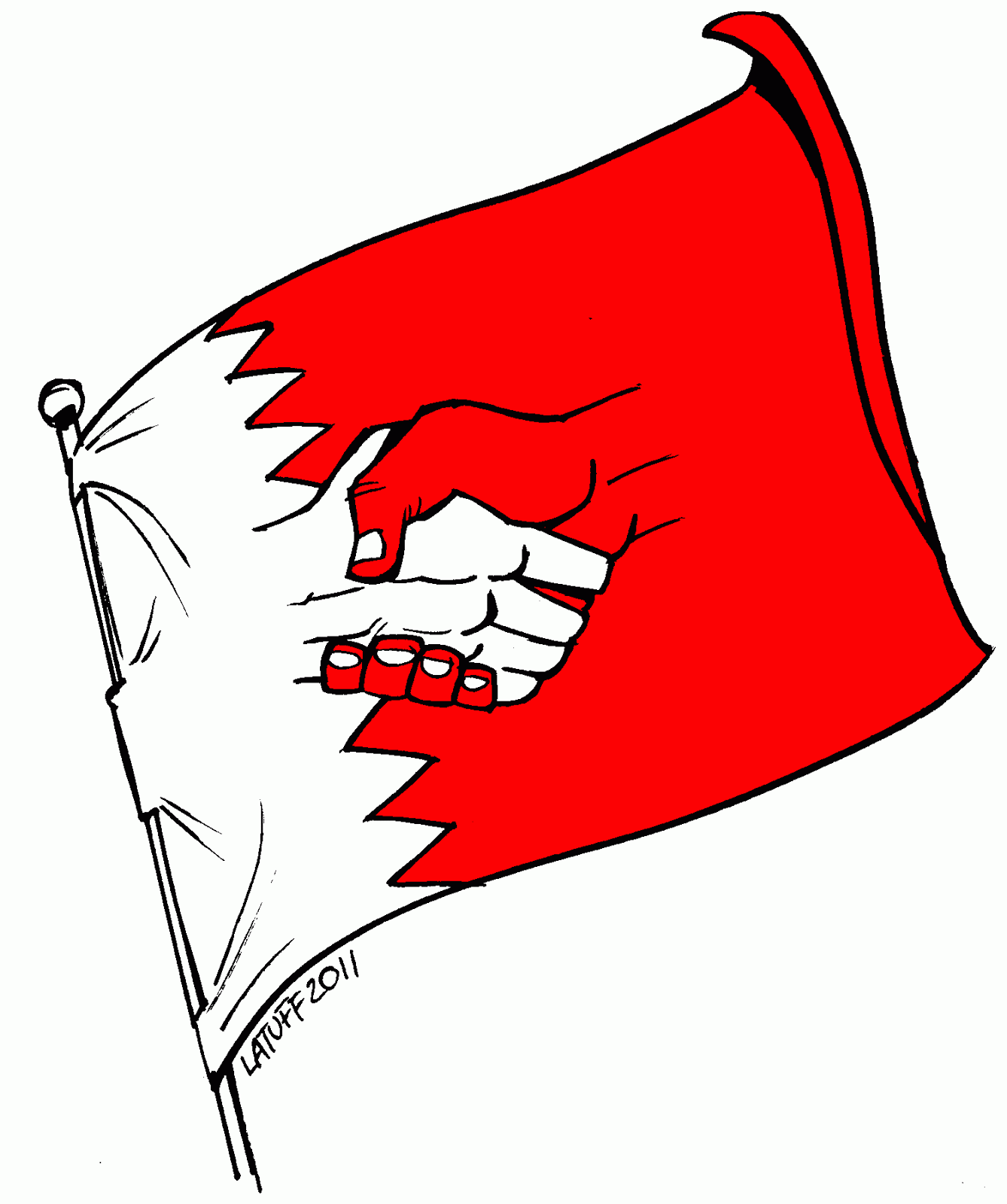
Bahrain’s contribution to the Arab Spring


The Bahraini government used the spectre of sectarian violence to justify their crackdown on peaceful protesters.

The Arab silence on the continued repression of the Bahraini people is a shameful episode that does not fit the era of the Arab revolution. It is also a testimony to the determination of the US-backed Gulf political order - that is leading the effort to place a cap on change in the Arab World - to prevent the revolution from reaching its member states.
The relative success of isolating the Bahraini movement by fomenting sectarian fears is regretfully a sign that the Arab Spring has not succeeded in doing away with sectarian prejudices that are not only impeding  effective solidarity, but threaten to tear up some Arab uprisings.
Part of the problem is that the Arab uprisings have not yet radically changed the official Arab order that consists of governments that have fed sectarian divisions to ensure their longevity. The fact that Bahrain’s population is 70 per cent Shia but is ruled by an authoritarian Sunni royal family have made it possible for governments to claim an Iranian scheme to undermine the stability of the Gulf and consequently the Arab world.

In fact, the people of Bahrain have given the regime several chances to reform, but repression will only drive people towards endorsing more radical demands of overthrowing the regime.
Although Bahrain is a young country, its history has shown that repression did not prevent the struggle for political freedoms to resume. It is about time that Arabs stood unequivocally with the Bahraini people who contributed to the Arab Spring, even as the Arab Spring failed them.
Follow me on twitter; @OhSweetArabia